
I've watched dozens of product launches stumble at the starting line.
The product ships. Sales has no battle cards. Support doesn't know the new features. Marketing sends out messaging that contradicts what engineering built.
The launch document exists somewhere in Notion or Google Docs. Nobody read it.
The teams that avoid this usually treat the launch as more than a status update. They turn the session into a product launch meeting that doubles as internal launch training and product demo training, so everyone sees the same narrative at the same moment.
Misalignment causes trust breakdowns, misdirection, and cultural rifts in startups. It's one of the leading causes of early failure. When teams aren't aligned on even one or two critical areas, execution stalls and problems cascade.
#The Problem with Launch Docs Nobody Reads
You spend weeks preparing the perfect launch document.
Product specs. Positioning. Target customers. Competitive analysis. Demo scripts. FAQs. Everything your team needs to execute.
Then you send it out. Maybe you get a few thumbs-up emoji reactions. Maybe someone asks a question in Slack three days later that's answered on page two.
The reality hits during the first customer call. Sales pitches features that don't exist. Support escalates tickets for "bugs" that are actually intended behavior. Marketing uses screenshots from the old version.
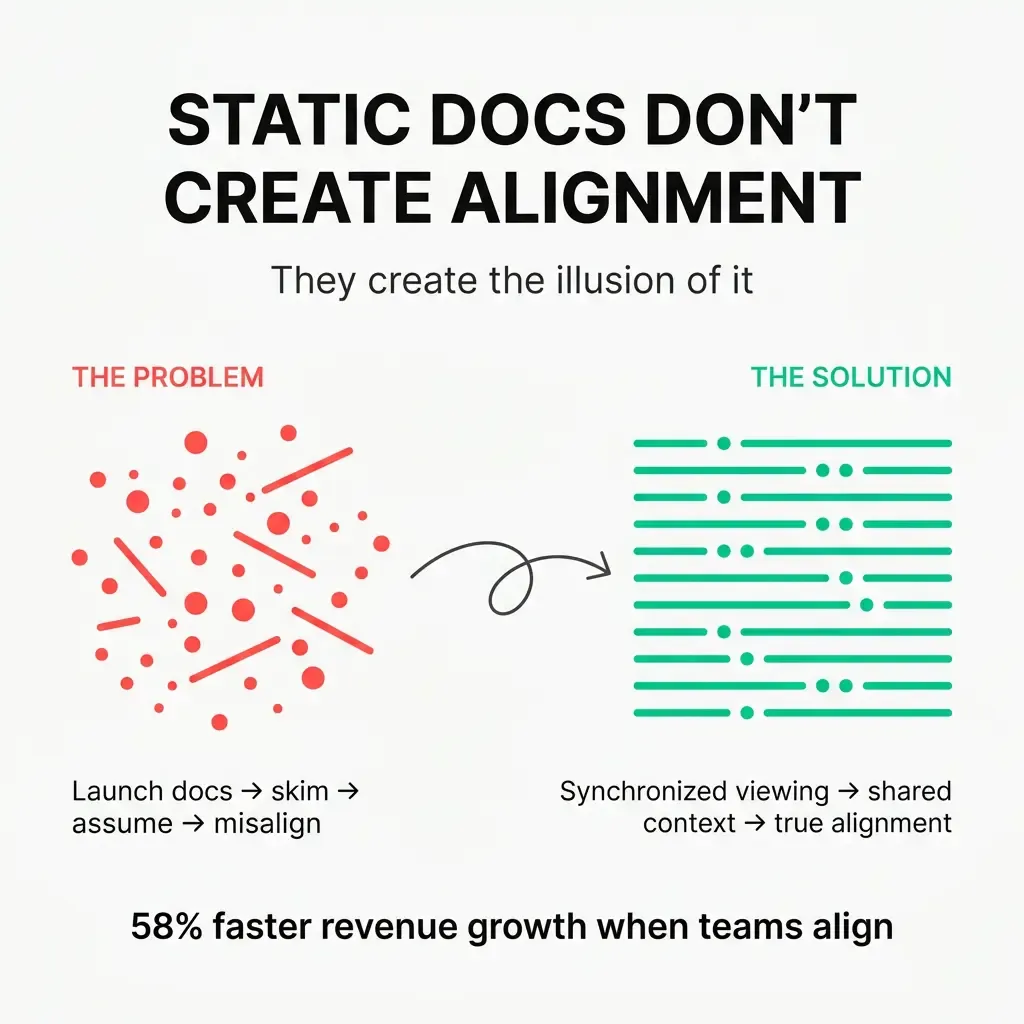
Static documents don't create alignment. They create the illusion of alignment.
Here's what actually happens: people skim the doc, assume they understand, and move on. The nuance gets lost. The context disappears. The "why" behind decisions never lands.
Research shows that highly aligned companies grow revenue 58% faster and are 72% more profitable. Companies that unify marketing, sales, and service are twice as likely to exceed revenue targets.
You can't build that kind of alignment with a PDF.
#The Launch Kickoff Meeting Pattern
The best product teams I've worked with run a different play.
They gather everyone in one session. Product, engineering, sales, support, marketing. They watch the product demo together. They pause. They discuss. They ask questions while the context is fresh.
This isn't a presentation. It's a synchronized experience.
The difference matters. When you present, people tune out. When you watch together, everyone sees the same thing at the same moment. The shared experience creates shared understanding.
I've run these sessions for major feature releases. The pattern works because it forces real-time processing. You can't skim a video. You can't jump to the end. You experience it linearly, together.
The questions that come up during these sessions are the ones that would have caused problems later. "Wait, how does that work for enterprise customers?" "What happens if they skip that step?" "Is that available on mobile?"
You catch misunderstandings before they become customer-facing mistakes.
#Why Video Processes Faster Than Text
Our brains process visuals 60,000 times faster than text. 90% of information sent to our brains is visual.
When you show someone how a feature works, they understand it immediately. When you write about it, they have to translate words into mental images. That translation introduces errors.
Video also captures tone, emphasis, and context that text strips away. You hear the excitement when the PM explains the problem this solves. You see the actual user flow, not a description of it.
This matters for launches. The difference between "users can filter results" and actually seeing the filter UI in action is the difference between confusion and clarity.
#Watching Demo Videos Together
Here's how the session structure works in practice.
You start with a short intro. Two minutes. Set context: what you're launching, why it matters, who it's for.
Then you play the demo video. Everyone watches together. Playback is synchronized, so you're all seeing frame 1,247 at the exact same moment.
This synchronization is critical. It's not just watching a video. It's watching the same video at the same time.
When someone has a question, you pause. Right there. At the exact timestamp where the confusion happened.
"Wait, go back to 8:32. What happens if they don't have that permission?"
You scrub back. You replay that section. You answer the question while the visual is on screen. Everyone sees the same thing while hearing the explanation.
Then you continue. The flow stays intact. The momentum builds.
#The Power of Shared Timestamps
Timestamps become a shared language.
"The pricing explanation at 14:20 needs work."
"Can we get a screenshot of the dashboard at 6:45 for the blog post?"
"Support should focus on the workflow starting at 11:30."
Everyone knows exactly what you're talking about. No ambiguity. No "which part do you mean?" back-and-forth.
This precision carries forward. When sales asks product a question two weeks later, they can reference the timestamp. When marketing needs clarification, they point to the exact moment.
#Live Discussion at the Exact Moment in the Video
The real magic happens in the pauses.
You're watching the demo. Someone from sales raises their hand. "Our enterprise customers are going to ask about SSO. Do we support that?"
You pause. Right there. At 12:15, where the login screen is visible.
Product answers. Engineering adds context about the implementation timeline. Sales understands not just the answer, but sees exactly where it fits in the user flow.
The discussion happens in context. Not in abstract. Not in a follow-up email thread. Right there, with the visual evidence on screen.
This prevents the broken telephone effect. When you discuss features abstractly, people build different mental models. When you discuss them while looking at the actual interface, everyone builds the same mental model.
I've seen launches where support thought a feature worked one way, sales thought it worked another way, and product built it a third way. All because they never looked at the same screen together.
#Questions That Surface in Real-Time
The questions you get during synchronized viewing are different from the questions you get via email.
They're more specific. More actionable. More revealing of actual confusion.
"What's the character limit on that field?"
"Can they undo that action?"
"How long does that process take?"
These are the details that matter in customer conversations. They're also the details that get lost in launch documents.
When you answer them live, with the video paused at the relevant moment, the answer sticks. People remember it because they saw it, heard it, and connected it to the visual.
#A Concrete Session Template
Here's the exact structure I use for product launch kickoff sessions:
00:00 - 02:00 | Intro Set the stage. What are we launching? Why does it matter? Who is it for? Keep it tight. Two minutes maximum.
02:00 - 12:00 | Watch Video Together Play the product demo. Everyone watches. Microphones muted. Full attention on the video. Let it run without interruption for this first segment.
12:00 - 15:00 | Pause for Discussion Stop playback. Open the floor. What questions came up? What needs clarification? Address concerns while they're fresh.
15:00 - 25:00 | Continue Playback Resume the video. Watch the rest of the demo together. Pause again if major questions surface, but try to maintain flow.
25:00 - 30:00 | Q&A Tied to Timestamps Final questions. Reference specific timestamps. "Can we go back to 8:45?" Jump to those moments. Clear up remaining confusion.
30:00 | Wrap Up Summarize key points. Confirm next steps. Make sure everyone knows their role in the launch.
#Adapting the Template
This structure flexes based on your needs.
Complex product? Add more pause points. Simple feature? Condense the timeline. Large team? Break into smaller groups and run multiple sessions.
The core pattern stays the same: synchronized viewing, contextual discussion, timestamp-based clarity.
I've run 15-minute sessions for small feature releases and 90-minute sessions for major product launches. The template scales.
#Why This Works for Internal Launch Training
Traditional training fails because it separates learning from context.
You sit in a conference room. Someone talks about features. You take notes. You try to remember everything. Then you go back to your desk and forget half of it.
Synchronized video sessions keep context and learning together.
Support sees exactly what customers will see. Sales watches the actual user flow they'll be demoing. Marketing observes the features they'll be writing about.
The training isn't abstract. It's concrete. Visual. Memorable.
Research shows 87% of users report feeling better engaged with colleagues through video. That engagement translates to better retention and understanding.
#Building Launch Readiness
Launch readiness isn't about having all the answers. It's about having shared context.
When your team watches the product demo together, they build that context. They see the same interface. They hear the same explanations. They ask questions together.
This shared experience creates alignment that documents can't.
Sales knows what engineering built because they watched it together. Support understands the edge cases because they asked about them during the session. Marketing gets the messaging right because they saw the actual product.
You're not hoping people read the launch doc. You're ensuring they experienced the product together.
#Making It Happen with ShortVibe
Running these sessions used to require complex video conferencing setups and manual coordination.
ShortVibe makes it simple. Upload your product demo videos. Set a date and time. Invite your team via email.
When the session starts, you control playback. Everyone sees the same frame at the same moment. You pause for discussion. You jump to specific timestamps. You run the entire kickoff session in one synchronized experience.
The chat stays tied to timestamps. Questions asked at 8:32 are tagged at 8:32. You can review them later. You can share specific moments with people who missed the session.
The session becomes a reusable asset. New team members can watch the recording with timestamp-tagged discussions intact. They get the full context, not just the video.
#From Chaos to Clarity
I've seen product launches go from chaos to clarity with this approach.
Teams that were fragmented become aligned. Questions that would have caused customer-facing problems get answered before launch. Everyone moves forward with the same understanding.
The launch document still exists. But it becomes a reference guide, not the primary source of truth. The synchronized session is where alignment happens.
Your next product launch doesn't have to start with crossed wires and confused teams.
Gather everyone. Watch the demo together. Discuss in context. Build shared understanding.
That's how you launch with alignment.