
I've watched sales enablement teams struggle with the same problem for years. They record training videos. They upload them to a platform. They send the link to new SDRs. Then they wait.
And wait.
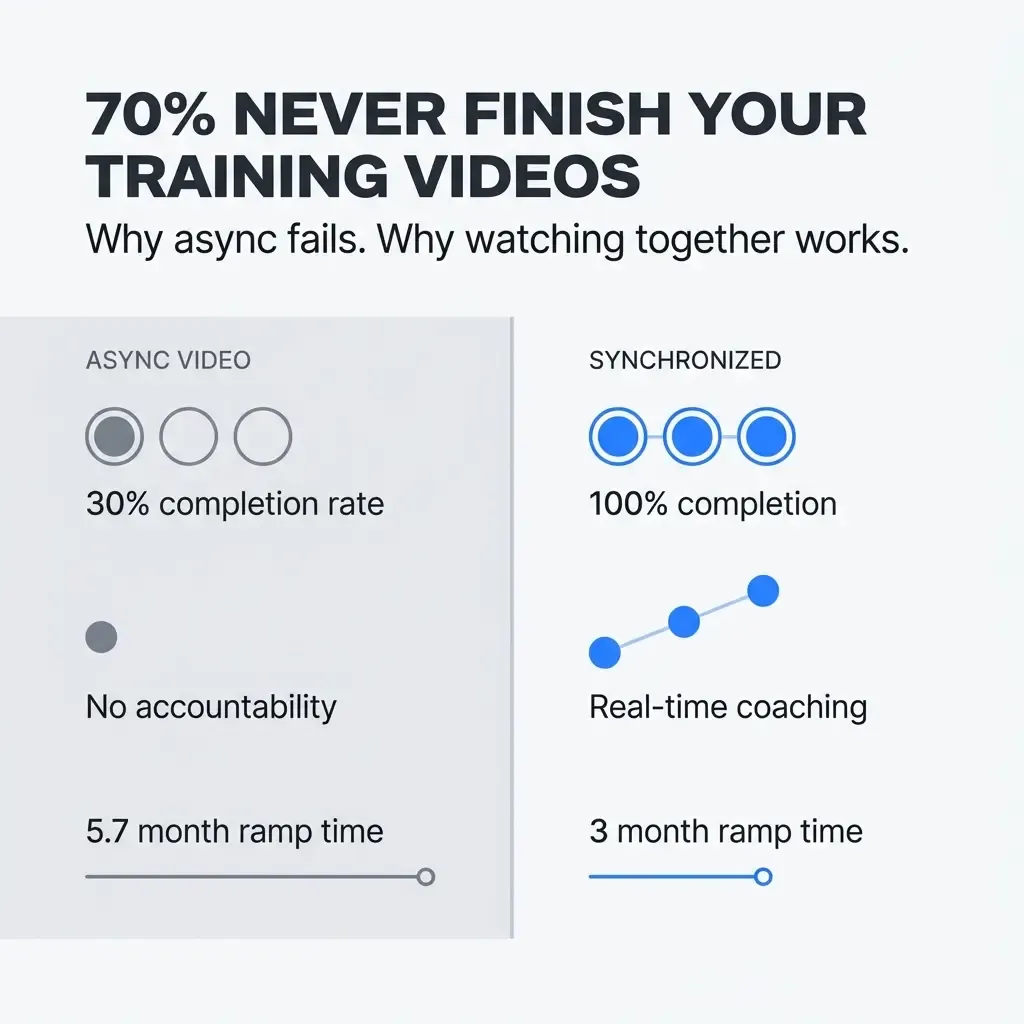
The completion rates tell the story. Only 30 percent of people finish online courses. For videos longer than two minutes, half your team stops watching. Your carefully crafted objection-handling training? Your product demo walkthrough? Most of your new hires never see the end.
I've built enough training systems to know this isn't a content problem. The videos are good. The information is valuable. The problem is the format itself.
#Why SDR Onboarding Fails With Async Video
Asynchronous video training operates on a flawed assumption: that learning happens when someone watches alone, at their own pace, without accountability.
Here's what actually happens.
Your new SDR opens the training video. They're motivated on day one. They start watching. Three minutes in, Slack pings. They pause the video. They handle the message. They come back. Where were they? They scrub through the timeline. They miss a key point. They keep watching.
By day three, the videos pile up. By week two, they're behind. By month one, they're winging it on calls because they never finished the training.
The data backs this up. Ramp-up time increased 32% from 4.3 months in 2020 to 5.7 months in 2025. That's nearly two extra months before your SDR becomes productive. At three times base salary to fully ramp a new rep, that delay costs real money.
Even worse, 20% of new sales hires leave within the first 90 days, primarily because of poor onboarding.
Async video training creates three specific failures:
No accountability. Nobody knows if your SDR watched the video or just marked it complete. Nobody knows if they understood it. Nobody knows if they retained anything.
No context. Your SDR watches a cold-calling technique but doesn't know when to use it. They see a demo flow but don't understand why you structured it that way. The information exists in isolation.
No feedback loop. They can't ask questions in the moment. They can't see how other team members interpret the same material. They can't course-correct their understanding in real time.
You end up with SDRs who technically completed the training but can't execute the skills.
#Why Watching Together Works Better
I've seen the difference when teams watch training videos together. The dynamic shifts completely.
Everyone shows up at the same time. The video starts. Nobody can skip ahead. Nobody falls behind. The playback is synchronized, so when your sales manager pauses to explain a technique, everyone sees it at the same moment.
This isn't about forcing attendance. It's about creating the conditions where learning actually happens.
Think about how you learned to code, or how you learned sales, or how you learned anything complex. You probably didn't do it alone with a video. You sat with someone who knew more than you. They showed you something. You asked questions. They corrected your misunderstandings immediately.
Synchronized viewing recreates that environment at scale.
The completion problem disappears. When you schedule a 30-minute watch party, people attend. They stay for the full session. You get 100% completion because the format itself demands presence.
The engagement problem disappears. Your SDRs can ask questions in chat while watching. They see other people's questions. They realize they're not the only one confused about territory assignment or CRM workflow. The shared experience builds understanding faster than isolated viewing ever could.
The retention problem improves dramatically. Studies show eLearning can boost knowledge retention rates up to six times higher than traditional methods. But that assumes the learning actually happens. Synchronized sessions ensure the information gets absorbed in the first place.
#How Synchronized Viewing Improves Coaching
Here's where synchronized training becomes powerful for sales enablement teams.
You're not just showing videos. You're coaching in real time while the content plays.
Your sales manager plays a recorded discovery call. Thirty seconds in, they pause. "See how the rep asked about budget before establishing pain? That's backwards. Let's watch what happens." They resume. The prospect gets defensive. The call stalls.
Everyone sees it together. Everyone understands why the sequence matters. Your manager doesn't need to schedule fifteen one-on-one sessions to make that point. They made it once, to everyone, in context.
This matters because structured programs deliver 37% faster ramp time and 82% higher retention. The difference between structured and unstructured isn't the content. It's the coaching layer wrapped around the content.
Synchronized viewing gives you several coaching advantages:
Immediate correction. When your SDR misunderstands a technique, you catch it during the session. You don't discover it three weeks later when they've been doing it wrong on fifty calls.
Shared learning. One person asks a question. Five others had the same question but didn't ask. You answer once. Everyone benefits. The knowledge spreads efficiently.
Behavioral observation. You see who's engaged. You see who's confused. You see who needs follow-up. You can't observe any of this with async video.
Pattern recognition. You can pause on specific moments and say, "This is what good looks like." Your team develops a shared vocabulary. They start recognizing patterns in their own calls.
The coaching happens when it matters most: during the learning, not after.
#Example Session Agenda (30 Minutes)
I've run dozens of these sessions. Here's a format that works.
0-2 minutes: Context setting
You explain what you're about to watch and why it matters. "Today we're reviewing three cold calls. Two worked, one failed. We'll identify the difference."
You set the learning objective. You prime your team to watch for specific things.
2-20 minutes: Synchronized viewing with pauses
You play the first video. You pause at key moments. You ask questions. "What did you notice about how she handled that objection?" You let people respond in chat. You add your perspective. You resume.
You repeat for the second and third videos. You're not just showing content. You're guiding attention to what matters.
20-25 minutes: Discussion
You open it up. "What patterns did you see across all three calls?" Your team shares observations. Someone notices the successful reps both asked about timeline early. Someone else notices the failed call never established budget authority.
The insights emerge from the group. You're facilitating, not lecturing.
25-30 minutes: Application
You make it concrete. "On your next ten calls, try asking about timeline in the first two minutes. We'll review results next week."
You give them one specific thing to practice. Not ten things. One.
This format works because it respects how people actually learn. You show them something. You help them understand it. You give them a chance to apply it. Then you follow up.
#How ShortVibe Enables Synchronized Training
I built ShortVibe because I kept seeing teams try to run watch parties with tools that weren't designed for it. They'd use Zoom and share their screen. They'd use Slack and hope everyone pressed play at the same time. They'd use their LMS and lose all the real-time interaction.
None of those tools solve the core problem: synchronized playback with coaching.
ShortVibe handles the mechanics that make watch parties work:
Synchronized playback. When the host pauses the video, everyone's video pauses. When they resume, everyone resumes. Nobody gets out of sync. You're all watching the same moment together.
Scheduled sessions. You set the date and time. You invite your team. They show up. The session starts. You're not chasing people to watch on their own time.
Built-in chat. Your SDRs can ask questions while watching. You can respond without stopping the video. The conversation happens alongside the content.
Host control. You decide when to pause, when to resume, when to replay a section. You maintain the coaching flow without technical friction.
The platform handles the infrastructure so you can focus on the training itself.
You upload your videos once. You schedule your sessions. Your team joins from anywhere. The playback stays synchronized. The chat keeps everyone engaged. You coach in real time.
This approach works for onboarding new SDRs. It works for ongoing enablement. It works for product launches. It works for any situation where you need your team to watch something together and actually retain it.
The alternative is sending another async video and hoping this time will be different.
It won't be.
Synchronized training isn't a nice-to-have. It's the difference between SDRs who ramp in three months and SDRs who ramp in six. It's the difference between 20% turnover and 82% retention. It's the difference between training that gets completed and training that gets applied.
You can keep fighting the completion rate problem with async video. Or you can bring your team together and actually train them.
I know which one works.