
I almost made the worst product decision without anyone asking me to.
I was building ShortVibe, a platform for synchronous watch parties of short videos. The core idea is simple: a host picks a time, uploads videos, invites people, and everyone watches together. Playback syncs across all screens. People chat. It's a micro-event built around concurrent presence.
Then I caught myself thinking about adding a "watch later" button.
Nobody requested it. Nobody said they needed it. But I'd noticed something in my own behavior that made the feature feel obvious: whenever I save articles or videos for later, I almost never go back to them. When I do, I usually just delete them.
That observation should have been a warning sign, not a feature spec.
#The Pattern I Missed in My Own Behavior
Someone recently sent me an hour-long video about a startup's AEO/GEO system. It showed how they improved their appearances in AI agent responses like ChatGPT or Gemini. I watched maybe the first ten minutes.
I couldn't concentrate through the whole thing. It included a full demo via screen share. I tried to skip to the interesting parts, but that never works. You miss context. You lose the thread. You end up closing the tab.
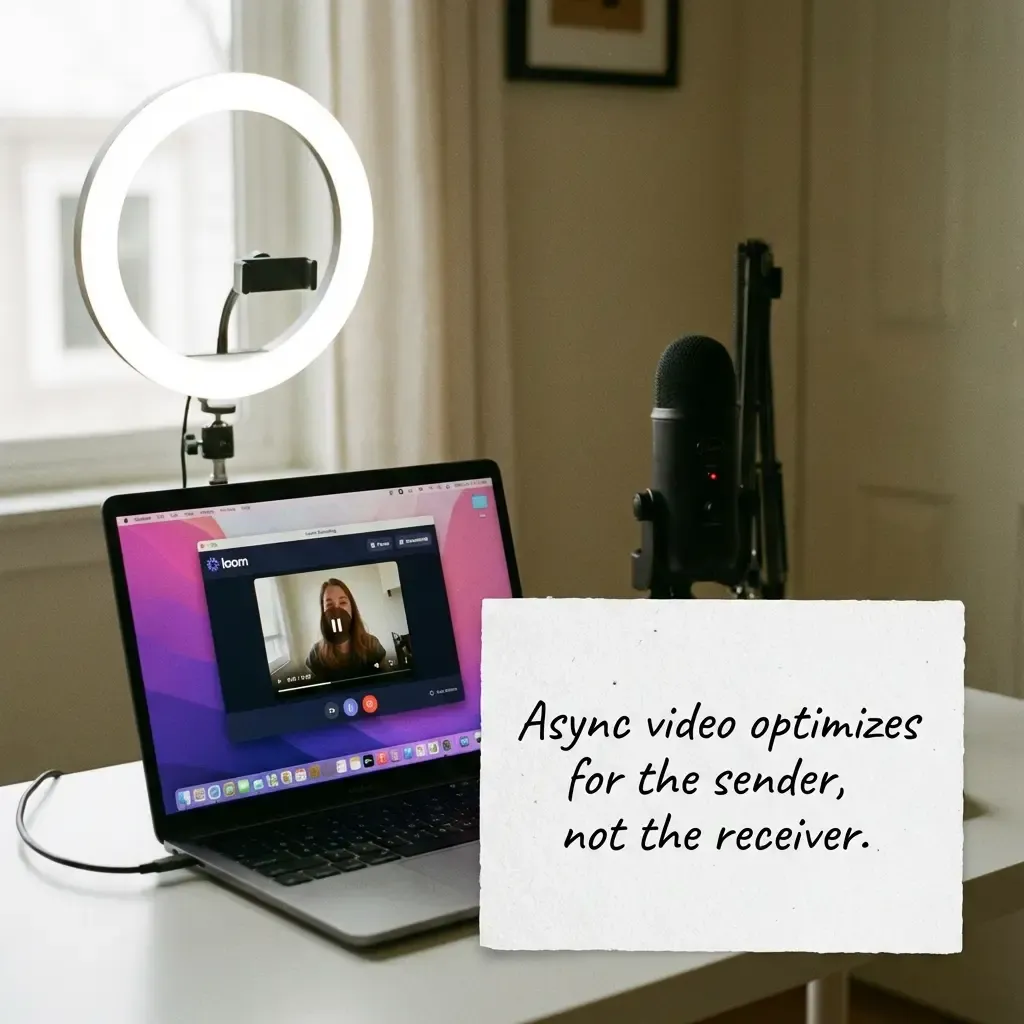
This happens constantly with async video. People record long Loom walkthroughs to "save time," but most of them go unwatched. The ones that do get opened get scrubbed through at 2x speed while the viewer hunts for something useful.
#Async video optimizes for the sender, not the receiver.
The sender feels productive. They recorded their thoughts. They delegated communication to a video file. But the receiver is stuck with an hour of unstructured content and no clear way to extract value without investing the full hour.
When I think about what receiver-optimized video would look like, I think about how I prep for a demo meeting. I select specific parts that target the person I'm meeting. If I'm talking to someone who runs entrepreneur events, I'll show them a ShortVibe demo with a series of videos from X where founders tell stories. Curated. Contextual. Short.
That's not what "watch later" enables. It enables accumulation without accountability.
#What Actually Happened When I Finished a Video Series
The last video content I actually finished was a collection on the Laravel PHP ecosystem. Each video ran under ten minutes. They structured it like an Advent calendar, revealing a new video each day.
Even though I already knew some of the material, I went through all of them. It felt like a workshop. Bite-sized. Sequential. Time-bound.
The structure created the commitment. The daily release rhythm created the habit. The short length made each session completable.
Compare that to the hour-long AEO demo I abandoned. The difference isn't just length. It's the entire framing of the experience.
One was designed for me to finish. The other was designed for someone to record.
#The Feature That Would Have Killed the Product
Adding "watch later" to ShortVibe would have turned a synchronous micro-event platform into another content graveyard.
The whole point of ShortVibe is concurrent presence. You show up at a specific time. You watch with other people. You chat about what you're seeing. The host controls playback. Everyone experiences the same moment together.
It solves one pain point well: screening a series of short videos to an audience and chatting about them.
Zoom can technically do this with screen share. That's the most common pushback I hear. But Zoom has dozens of features that complicate the experience. Most of them are distractions. ShortVibe focuses entirely on the video screening and the chat around it.
If I added "watch later," I'd be admitting that the synchronous moment isn't actually valuable. I'd be saying, "Sure, you can watch together, but if you can't make it, just catch up on your own."
That sounds reasonable. It sounds user-friendly.
It would destroy what makes the product different.
#Why Sync Moments Make Teams Faster
I've worked with remote teams at startups and big companies. The pattern I've seen is that adding synchronous moments actually makes teams faster, not slower.
Two types of sync moments consistently deliver speed gains: brainstorming sessions and social gatherings.
Most remote teams treat social gatherings as "nice to have" luxuries. They're wrong.
A 30-minute social gathering brings you up to speed on what's going on. You get a concentrated dose of context. It's like a cold drink during a long walk when you're touring a city. You get a social vibe from the concurrent presence. After that, you feel energized.
Last week I had that feeling when meeting with a prospective customer for another project. Before the meeting, I was working in parallel on three ideas. Only one is built. Compared to other solo founders, these are more ambitious ideas. All based on groups of people cooperating.
I was carrying doubt: maybe my ideas are too complicated, too difficult to sell.
When I sat with that person, something shifted. They liked the ideas. They said, "You're geared towards these concurrent presence ideas."
That energized feeling isn't just emotional comfort. It's cognitive fuel. The next two weeks of work move faster because you have clarity, context, and momentum.
Async communication doesn't give you that. You can't get energized by a Slack thread.
#The Mental Test I Use for Product Decisions
When I'm deciding if a feature belongs in ShortVibe, I ask: does this move us toward enterprise-level complexity or does it keep the micro-event vibe?
Anything that makes the product feel like a team collaboration suite is a dilution. Anything like handling invitation responses that can be postponed—because the core is very small and simple—dilutes focus.
The core of ShortVibe is tiny: schedule a time, upload videos, invite people, watch together, chat.
Every feature I consider gets tested against that core. If it pulls away from the micro-event experience, it doesn't belong.
"Watch later" would have pulled away. It would have turned a focused, time-bound event into an optional, whenever-you-get-to-it content library.
#What I Learned From Killing a Startup Too Slowly
I built an auction events platform years ago. After launch, nothing happened for weeks. I was exhausted from development. I'd been hoping people would show up after a few posts on social media.
Nobody arrived.
I spent those first weeks reading books on marketing and business. The conversation in my head was: I don't know how to do marketing, so I should learn, then proceed to the next step.
I optimized for low burn rate to increase runway. I kept cutting the marketing budget, telling myself I just needed to be patient.
Looking back, I should have spent three times more at the beginning, failed fast, and killed the idea. Instead, I waited six to eight months before hiring someone to do marketing.
The lesson: optimizing for low burn rate when you need signal is insignificant. You're better off doing a push and throwing money at the problem at the start.
If you're in month three, cutting your budget, and telling yourself you need to be patient—cut your losses. The runway you're preserving isn't helping you learn faster.
#Why I Keep Building Concurrent Presence Products
I've been chasing this idea for a long time. Every time I look on X or Reddit, the same doubt surfaces: maybe my ideas are too complicated, too difficult to sell.
But concurrent virtual presence is my passion. It started when I wrote a blog article years ago about how to program live auctions with Node.js. The core idea in that article was pushing updates from the server to the web page instead of the web page polling the server.
Building live auctions added real-time chat and video streaming. Taken together, that made me realize this is the thing I keep chasing.
ShortVibe is a small part of that huge auction events platform, rebuilt for a specific purpose and pain point.
The reason I didn't add "watch later" is the same reason I keep building these products: I believe the synchronous moment is where the value lives.
Async tools are everywhere. They're useful. But they don't create the energized feeling you get from being present with other people at the same time.
The most requested feature isn't always the right feature. Sometimes it's the thing that destroys what makes you different.
I'm building for the people who want to show up, watch together, and feel that presence. If you want to watch later, there are a thousand tools for that already.
This one is for watching now.