
I've fallen asleep during my own onboarding more times than I care to admit.
The pattern was always the same. Someone would send me a link to a 20-minute video. I'd open it, full of good intentions. By minute 15, my eyes would glaze over. By minute 18, I'd be fighting to stay conscious.
The problem wasn't the content. The problem was the format.
#The Illusion of Completion
Companies track video completion rates like they mean something. They celebrate when 80% of new hires finish the onboarding videos. They assume watching equals learning.
It doesn't.
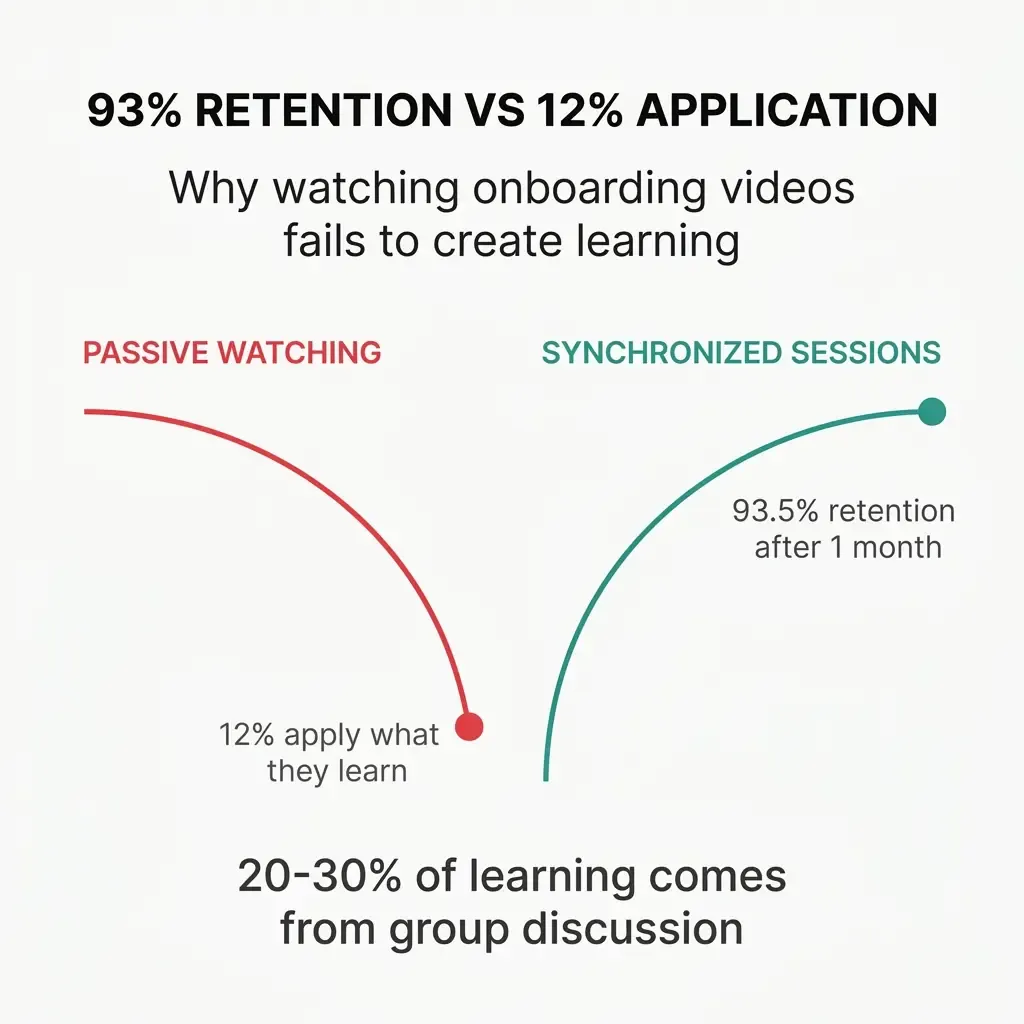
Only 12% of people who do workplace training actually apply what they learn to their work. That's not a learning problem. That's a design problem.
Passive watching creates passive learners. You sit alone, absorbing information with no way to test your understanding, no one to ask questions, no context for why this matters. The video ends, you click "complete," and the system marks you as trained.
But two days later, you remember almost nothing.
Active learners retained 93.5% of information after one month compared to only 79% for passive learners. That 14.5% gap compounds over time, determining whether your onboarding creates capable employees or confused ones.
#The Isolation Problem
When I watched onboarding videos alone, I had three options when something confused me: rewind and watch again, skip it and hope it makes sense later, or give up and ask someone the next day.
None of those options work well.
Rewinding doesn't help if the explanation was unclear the first time. Skipping creates knowledge gaps that show up weeks later. Waiting until tomorrow means you've already moved on mentally.
The real problem runs deeper than timing. More than 30% of employees find remote onboarding worse than pre-COVID experiences, citing isolation and lack of connection as primary factors.
Learning alone means missing the cross-fertilization that happens when people from different backgrounds watch the same content. I realized this during a synchronized session when someone said, "The question is not technical, it's business and marketing."
That reframing would have taken me weeks to figure out on my own. In a group session, it took 30 seconds.
20-30% of actual learning comes from group discussion, not from the video content itself.
#Anatomy of a Failed Onboarding Video
Three factors guarantee your onboarding video will fail: length, monotony, and isolation.
Length kills attention. Videos under three minutes have 91% completion rates. Longer videos drop to 66%. Traditional onboarding videos run 15-20 minutes of continuous content, guaranteeing disengagement before employees reach the valuable information.
I've sat through these marathons. The first five minutes, you're engaged. By minute ten, you're checking email. By minute fifteen, you're fighting sleep. The content might be important, but your brain checked out ten minutes ago.
Monotony kills retention. One person talking at a camera for 20 minutes creates the same problem as a bad lecture. Your mind wanders. You miss key points. You can't stay focused on a single voice delivering information without variation in pace, tone, or format.
I needed something closer to a TikTok experience. Short bursts of 10-20 seconds, then a break to process, then another segment. That rhythm matches how people actually consume information today.
Isolation kills application. When you watch alone, you can't test your understanding in real time. You can't hear how others interpret the same information. You can't ask questions when something doesn't make sense.
Self-paced courses have completion rates as low as 3%. Cohort-based courses often achieve completion rates over 90%. The gap isn't about content quality. It's about structure and accountability.
#The Synchronized Session Framework
I built ShortVibe around a different approach: synchronized video sessions that combine the focus of watching with the learning power of group discussion.
Here's how a 30-minute session works:
Structure: Six 5-minute video segments
Each segment covers one discrete topic. Five minutes is short enough to maintain attention but long enough to develop an idea completely. The built-in pause points between segments create natural moments for questions and discussion.
You're not chopping a long video into arbitrary chunks. You're designing each segment as a standalone piece that builds toward a larger understanding.
Ratio: 70-80% video, 20-30% discussion
Most people assume you need more discussion time if 30% of learning comes from the group. I do the opposite.
The session needs to feel like a TED talk, not a conversation. The video provides the structure and content. The discussion provides the context and application. If you flip to 50/50, it becomes a meeting, not a learning experience.
Control: Facilitator manages playback
The facilitator controls when the video plays and when it pauses, like a movie screening. This solves a problem that breaks most group video sessions: people watching at different speeds, missing content, or getting ahead of each other.
Synchronized playback means everyone sees the same thing at the same time. Questions come through chat, not by speaking out loud, because speaking disrupts the viewing experience for everyone else.
Planning: Scripted pause points
You plan the structure beforehand. Segment one covers X, pause for questions about X. Segment two covers Y, pause for discussion about how Y relates to X. Segment three introduces Z, pause to address confusion about Z.
This planned structure beats reactive pausing because you've thought through what people will need to discuss at each point. You're not guessing in the moment.
Sometimes the group wants to discuss something different than what you planned. When that happens, I suggest waiting a few videos further in the sequence. The question they're asking often gets answered in the next segment, and discussing it prematurely creates confusion.
#Why Even In-Person Sessions Work Better at Desks
This contradicts everything companies believe about bringing people together, but in-person onboarding works better when people stay at their desks watching synchronized video rather than gathering in an auditorium.
Two reasons: physics and chat.
The physics problem: Auditoriums have acoustics issues, sightlines problems, and distance from the screen. Someone in the back row can't see details. Someone near a speaker hears distortion. The room itself creates barriers to learning.
At your desk, you control your environment. Screen at the right distance, audio at the right volume, lighting that works for you. The physical setup supports focus instead of fighting it.
The chat problem: In an auditorium, asking a question means raising your hand and speaking out loud, which disrupts everyone's viewing experience. Most people don't ask because they don't want to interrupt.
With integrated chat, questions flow in without breaking anyone's focus. The facilitator sees them in real time and addresses them at the planned pause points. People who would never speak up in a room will type a question in chat.
The act of watching demands focus. Speaking out loud breaks that for everyone. Chat lets you capture the question without disrupting the experience.
#Implementation Specifics
The technical setup matters less than the facilitation approach.
Group size: Keep cohorts small enough for discussion but large enough for diverse perspectives. Five to twelve people works well. Smaller than five and you lose the cross-fertilization benefit. Larger than twelve and some people stop participating.
Timing: Schedule sessions at a consistent time. Tuesday at 10am for all new hires means people can plan around it. Random scheduling creates no-shows and forces rescheduling.
Facilitation: The facilitator isn't teaching. They're managing the experience. Play the video, monitor chat for questions, pause at planned points, facilitate brief discussions, move to the next segment. The video does the teaching. The facilitator creates the environment for learning.
Questions during playback: This gets delicate. When questions come in via chat during a video segment, you balance momentum versus addressing confusion. Most questions get answered in the next segment or at the planned pause point. Stopping mid-segment breaks the flow and confuses people who were following along.
The five-minute segment length helps here. The longest anyone waits for their question is five minutes, which feels manageable. Longer segments create frustration when someone is confused and has to wait 15 minutes for clarification.
#What to Measure
Completion rates tell you almost nothing about learning effectiveness.
Track these instead:
Time to productivity: How long until new hires can complete their first real task without help? Synchronized sessions with discussion should cut this time significantly because people get their questions answered immediately instead of discovering gaps weeks later.
Question volume and type: More questions during sessions means people are engaged and thinking critically. The types of questions tell you what's unclear in your content. "How does this work?" means you need better explanation. "Why do we do it this way?" means you need better context.
Retention at 30 days: Test what people remember a month later. This reveals whether they actually learned or just watched. Companies with training completion rates exceeding 80% report 34% higher employee engagement scores, but completion means nothing if retention is zero.
Application rate: What percentage of new hires actually apply what they learned? This is the only metric that matters for business impact. Everything else is a proxy.
#Scaling Without Breaking
The framework works when you have five new hires per month. It needs adjustment when you hit 50.
You can't run one massive session with 50 people. The discussion breaks down. Questions pile up. People disengage because they're just watching, not participating.
Instead, run multiple smaller sessions with the same content. Record one high-quality video set. Use it across all cohorts. The facilitator role rotates among team leads or managers, which distributes the load and gives more people ownership of onboarding.
The video content stays consistent. The facilitation adapts to each group's specific questions and background. Someone with a technical background needs different context than someone coming from sales.
Organizations with strong onboarding programs see 82% improvement in retention and productivity increases over 70%. That ROI scales when you build the system right from the start.
#Why This Works When Everything Else Fails
28% of new hires quit within their first 90 days. Most churn stems from unclear onboarding, not from lack of product features or company capabilities.
Synchronized sessions eliminate the ambiguity that drives early departures. You learn with peers who have the same questions. You get immediate answers instead of struggling alone. You build connections on day one instead of feeling isolated.
The format matches how people actually learn. Short segments maintain attention. Group discussion provides context. Structured pause points create space for questions. Facilitated sessions ensure everyone stays on track.
You're not asking people to sit through a 20-minute lecture and hoping they remember it. You're creating an experience where learning happens through a combination of content and conversation.
I fell asleep during traditional onboarding because it was designed to fail. Long videos, solo viewing, no interaction, no accountability.
Synchronized sessions fix all of that. The video provides structure. The cohort provides accountability. The discussion provides understanding. The facilitator provides guidance.
It's not complicated. It's just different from what most companies do.
And different is what works.